Sambrow Journal · Markham
Modern Lip Blush vs the 90s Lip Tattoo: What Actually Changed
Needle depth, pigment chemistry, healed result — by Sam Liang
TL;DR
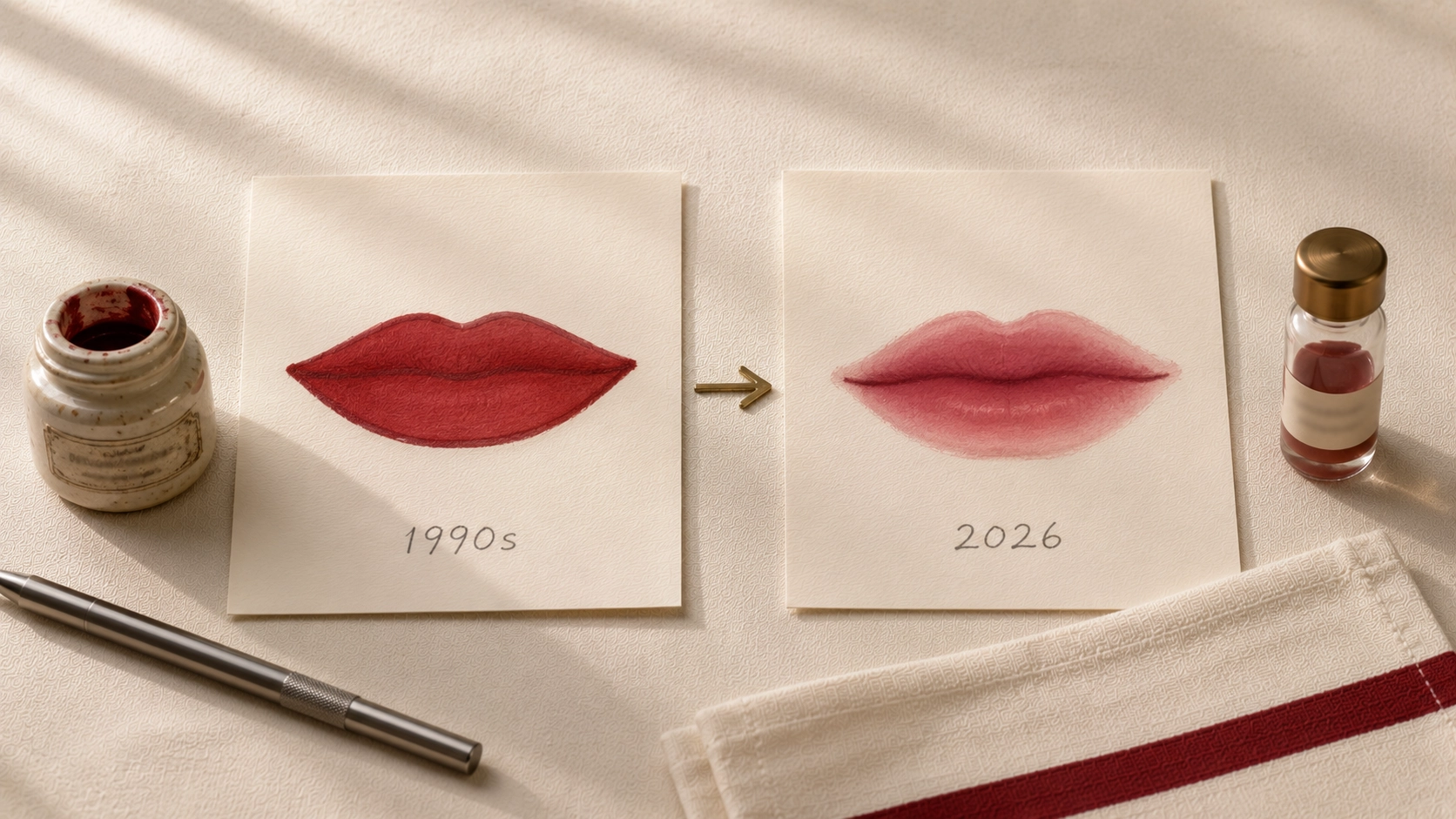
The 'permanent lipstick looks tacky' reputation is real but outdated by 25 years. The 1990s lip tattoo used deep dermal placement (1.5–2.5mm vs modern 0.5–1mm), saturated single-tone pigment with carbon-black or non-cosmetic dye base, hard outlined borders, and a single-session approach without colour layering. Result: a dark, fixed, often blue-green-aging line that lasted 5–10 years. Modern lip blush uses ultra-fine needles, iron-oxide pigment in translucent layers, no hard outlines, and a two-session approach. Result: soft natural lip-colour enhancement lasting 18–24 months and fading to soft beige rather than green. If you have an old lip tattoo: removal options exist (laser, saline lightening) before modern lip blush, but the modern version is a different procedure under a similar name.
New to lip blush? Read the complete guide: what it is, cost and healing →90s Lip Tattoo (Historical Reference)
Deep dermal placement + single-tone saturation + hard outlined borders
- Best for
- Nothing today — this technique is obsolete and discontinued at all reputable studios
- Duration
- 5–10+ years (effectively permanent)
- Comfort
- 5–7 / 10 — deeper placement, often longer sessions
- Finish
- Saturated dark single-tone with crisp outline — visible at any distance
Pros
- + Long duration without touch-up requirement
- + Strong colour visibility for clients of that aesthetic era
Cons
- − Heals dark and often shifts cool over years (blue-green aging is the common end state)
- − Hard outline reads as 'painted on' at any conversational distance
- − No colour theory for skin undertone — same pigment used across all clients
- − Carbon-black or non-cosmetic pigment can cause MRI complications, granulomas
- − Effectively permanent — removal requires laser or surgical revision
- − Cannot be 'updated' with modern lip blush without first lightening
Modern Lip Blush (2026)
Shallow placement + translucent layered iron-oxide + no hard outline + two-session protocol
- Best for
- Anyone wanting natural-looking colour enhancement that ages out gracefully
- Duration
- 18–24 months (designed to fade)
- Comfort
- 2–3 / 10 with proper numbing
- Finish
- Translucent layered colour — soft sheer to medium-saturated, no visible outline
Pros
- + Heals to natural-looking lip colour at all distances
- + Iron-oxide pigment is cosmetic-grade with established safety record
- + Fades to soft beige — no green / blue aging
- + Custom colour theory per client undertone
- + Two-session approach allows refinement based on actual healed colour
- + MRI-compatible (modern pigment brands publish compatibility statements)
Cons
- − Shorter duration than 90s tattoo — requires touch-ups
- − Cannot be applied over existing 90s lip tattoo without lightening first
- − Higher cost per cycle (offset by significantly better outcome)
Side-by-Side Technical Comparison
| 90s Lip Tattoo (Historical Reference) | Modern Lip Blush (2026) | |
|---|---|---|
| Placement depth | 1.5–2.5mm (deep dermal) | 0.5–1mm (epidermal-dermal junction) |
| Pigment type | Carbon-black, non-cosmetic dyes | Iron-oxide, cosmetic-grade |
| Application style | Single saturated layer | Translucent layered build |
| Border treatment | Hard outline drawn first | Soft diffused gradient, no outline |
| Session structure | Single session | Initial + 6–8 week touch-up |
| Colour theory matching | Standard shade for all | Custom per undertone |
| Healed colour stability | Shifts blue / green over 5–10 years | Fades to soft beige in 18–24 months |
| MRI compatibility | Risk of heating / artifact | Compatible with modern brands |
| Effective duration | 5–10+ years (semi-permanent) | 18–24 months by design |
| Markham price (modern) | Discontinued | $500–900 incl. touch-up |
How to Decide Based on Your Starting Point
Choose New to Lip Pigment — Choose Modern Lip Blush
If you have never had lip pigment work done, the 90s 'lip tattoo' is not even an option at any reputable Markham studio in 2026. Modern lip blush is the only current procedure. Concerns about 'looking permanently painted' apply to the 90s technique, not to modern lip blush — different procedure entirely.
Choose Have Old Lip Tattoo — Removal First
If you have an existing 90s-era lip tattoo, the path to modern lip blush requires lightening first. Options: laser removal (Q-switched, 3–5 sessions, $200–400 each), or saline lightening (slower but gentler). After full lightening, wait 6 weeks, then proceed with modern lip blush. Total cost: $700–2,500 depending on starting saturation.
Choose Have Faded Modern Lip Blush — Maintenance Touch-Up
If you have lip blush that is now 18+ months old and faded, a maintenance touch-up ($250–350) refreshes without starting over. No lightening needed since modern pigment fades gracefully. This is the easiest scenario.
Frequently Asked Questions About Modern vs Old Lip Tattoo
How do I know if my old lip work is '90s tattoo' or modern lip blush? +
Three indicators: (1) when was it done — pre-2010 likely 90s technique, post-2015 likely modern, (2) does the outline look hard / drawn vs soft gradient — hard = old, (3) has the colour shifted blue / green / dark over time — yes = old. If unsure, bring photos of fresh state and current state to consultation. We can assess from photos.
Can the 90s lip tattoo be completely removed? +
Mostly yes, partially in some cases. Q-switched laser removes 70–90% of carbon-based pigment over 3–6 sessions. The remaining 10–30% can be colour-corrected with modern lip blush layering. Complete removal to original natural lip state is sometimes possible but more difficult than partial fade — discuss realistic targets at consultation.
Why does the old lip tattoo turn blue or green over time? +
Carbon-based pigment oxidises in deep dermal tissue over years. The warm components of the original colour fade first, leaving the cool carbon base visible. Modern iron-oxide pigment fades evenly across the warm-cool spectrum, so it stays in the same colour family throughout its life.
Will my old lip tattoo show through modern lip blush done on top? +
Yes, partially, unless the old work is first lightened. Modern lip blush pigment is translucent — it layers over the existing colour rather than covering it. If you put modern lip blush over old saturated tattoo, the healed result is the underlying tattoo + a colour shift from the new pigment. The result is rarely what clients want. Lightening first is the right path.
Is removing old lip tattoo painful? +
Saline lightening: 3–4 / 10 with topical numbing, similar to the original lip blush sensation. Laser removal: 4–5 / 10 in shorter pulses, less prolonged than a tattoo session. Both have 14-day healing windows similar to lip blush. Neither is more painful than the original lip tattoo was.
What if I'm okay with my old lip tattoo and just want a touch-up? +
Reputable artists generally will not 'touch up' a 90s technique tattoo — the technique is no longer practised. Options: (1) keep what you have until natural fade, (2) lighten and switch to modern lip blush, (3) accept that the old work will remain as-is. Some clients in the third category use lipstick over the existing tattoo to soften the appearance — works for some, not all.
Are lip injections / fillers related to either of these? +
No — fillers add volume with hyaluronic acid, neither lip blush nor old tattoo adds volume. Fillers are unrelated to the pigment-deposition procedures. You can combine modern lip blush with fillers (sequence matters — lip blush first, see the worth-it guide). Old lip tattoos and fillers also coexist but the lip tattoo will limit colour theory choices for any pigment-related additions.
Will modern lip blush look like an old lip tattoo in 20 years? +
No. Modern iron-oxide pigment fades to soft beige in 36–48+ months. By year 5 it has typically faded to a hint of warmth — not the dark blue-green look of 90s tattoos at year 10. If you stop touch-ups at year 5+ and let modern lip blush fully fade, the residual is a subtle warm tone rather than a visible 'tattoo ghost'.
Considering modern lip blush or dealing with an old lip tattoo?