Sambrow Journal · Markham
Lip Blush Too Dark After Treatment? 6 Cases, Real Causes, and When to Wait vs Act
The honest triage — Day 1 panic, true saturation, wrong undertone, and chronic darkening — by Sam Liang
TL;DR
About 1 in 3 lip blush clients message their artist within the first 7 days convinced 'it's way too dark'. Almost every one of those messages resolves on its own by Day 21 — the lips look 2–3x more saturated immediately post-procedure because surface pigment has not yet sloughed. But a real subset of 'too dark' complaints (about 5–8% of all cases by week 4) is a genuine outcome issue that needs correction. The honest triage: wait through Day 21 before judging, document with photos in matched lighting, and bring concerns to the week 6–8 touch-up — where most real darkness issues can be lightened, neutralised, or rebalanced. This guide breaks down 6 specific 'too dark' cases by severity (minor / watch / urgent), the actual causes behind each, and the exact correction protocol used at Sambrow Markham.
New to lip blush? Read the complete guide: what it is, cost and healing →When to Wait vs When to Act
Almost every Day 1–7 'too dark' message is the surface pigment plus acute inflammation. By Day 14 the lips have already lightened 50–70% versus Day 1. By Day 28 they sit at about 95% of final intensity. Real 'too dark' problems are evaluated at the week 6 touch-up, not before. The only situations that need same-day medical attention are: spreading redness with fever (possible infection), pigment migrating visibly beyond the natural lip border (vascular issue), active blistering or clustered vesicles (HSV outbreak), or sudden hard swelling not consistent with normal Day 1 puffiness. Everything else — including all six cases below — needs time and the touch-up window.
Day 1–3: Lips look 2–3x darker than the chosen colour, almost black or deep maroon
MinorLikely causes
- •Surface pigment has not yet sloughed — what you see on Day 1 includes both the dermal pigment AND a top layer that will peel off
- •Acute inflammation has temporarily 2–3x'd visual saturation by swelling the lip tissue and concentrating pigment in a smaller area
- •Day 1 photos in indoor / yellow lighting also exaggerate red and brown wavelengths
What to do
- →Wait — do not message panic, do not book an emergency touch-up
- →Photograph daily in window light to track the lightening trajectory
- →Re-read the lip blush healing timeline guide and check that your Day 1 looks similar to other normal Day 1 examples
- →If by Day 21 it still feels too dark, message your artist with photos for the week 6 touch-up plan
Day 14–21: Colour is still noticeably more saturated than the consultation swatch
Watch closelyLikely causes
- •Pigment was placed deeper than intended (more dermal coverage)
- •Skin chemistry retained pigment more strongly than predicted (often happens with low-oil skin types)
- •Multiple over-passes during the session — common when the artist chases an 'even-out' on an asymmetric lip
- •Original swatch reference was in different lighting than your healed view
What to do
- →Bring matched-lighting photos to the week 6–8 touch-up
- →At touch-up the artist can use a saline lightening pass to lift 15–25% of pigment OR neutralise with a complementary tone
- →Avoid sun exposure deliberately — you want UV fade to assist the lightening over the next 8 weeks
- →Do not attempt at-home lightening (lemon juice, scrubs, peels) — these displace pigment unpredictably and can cause patches
Healed colour reads cool — blueish, greyish, or purple-toned — instead of the warm rose / mauve chosen
Watch closelyLikely causes
- •Pigment was placed slightly too deep (cool wavelengths scatter more from depth)
- •Wrong undertone selected at consultation — clients with olive or yellow undertones often need a warmer pigment base than they realise
- •Skin's own undertone is shifting the pigment colour through the healed layer (additive optics)
- •Smoking has oxidised the pigment toward a cool grey tone (especially in the first 6 weeks)
What to do
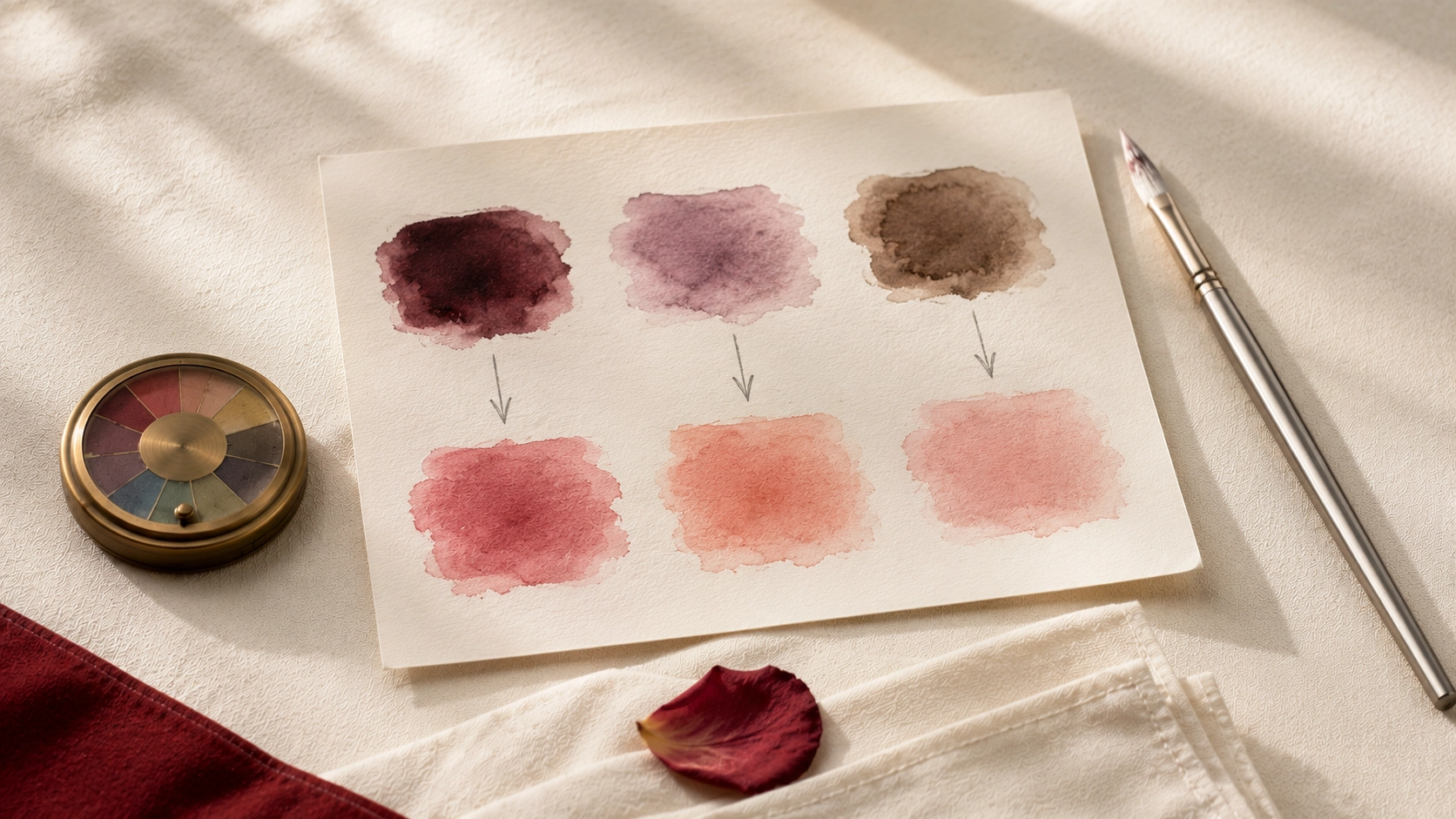
- →At the week 6 touch-up, apply a warm corrective layer (peach, coral or warm rose) over the cool-reading area — this is the standard neutralisation
- →If the cool tone is severe, a saline lightening session 4 weeks before the colour correction may be needed
- →Stop nicotine fully — the oxidation continues even at low exposure
- →Wear daily SPF lip balm with no white minerals — some zinc-based SPF leaves a slight cool cast that compounds the issue
One side of the lip is visibly darker, more saturated, or more defined than the other after Day 14
Watch closelyLikely causes
- •Bilateral skin chemistry variance — one side genuinely retained more (very common, about 50% of clients heal asymmetrically)
- •Dominant sleeping side absorbed more friction during the first 3 nights, lifting pigment unequally
- •Original anatomy was slightly asymmetric and the artist worked the lighter side harder to compensate, over-correcting
- •Sun exposure was uneven (driver-side lip in Markham faces stronger UV during commuting)
What to do
- →Almost always the cleanest touch-up case — at week 6–8 the artist works only on the lighter side to bring it up to match
- →If the darker side needs lifting (rare), saline lightening is applied only to that side
- →Most asymmetry resolves visually within 4 weeks of touch-up healing
You have naturally darker / pigmented lips and the healed result reads muddy, brown-black, or 'covered'
Watch closelyLikely causes
- •The neutralisation step was skipped at the initial session — pigmented natural lips need a base layer of peach or warm corrector before the target colour is applied
- •Single-session approach attempted on lips that required a two-stage neutralisation across two sessions
- •Wrong target shade chosen — going too light too fast on a dark natural lip always reads muddy
What to do
- →At week 6–8 touch-up, the artist applies the corrective base layer that should have happened originally
- →For severe muddy heal, a full two-stage correction may take an extra session (pricing depends on an in-person assessment; request a current written Sambrow quote)
- →Realistic target: dark natural lips typically heal to a 1–2 shade lift from baseline, not a complete colour transformation — anyone who promised more was overselling
The lips have been continuously darkening over multiple months — getting noticeably darker at month 3, 6 or beyond, rather than fading
UrgentLikely causes
- •Post-inflammatory hyperpigmentation (PIH) — the skin itself is producing extra melanin in response to ongoing irritation
- •Chronic irritation source still present — menthol balm, smoking, scrubbing, retinol leakage from skincare
- •Sun exposure without lip SPF accelerating melanin formation in the healed area
- •Underlying condition (rare) — hormonal melasma extending to lip area, drug-induced pigmentation
What to do
- →See a dermatologist first — this is the one 'too dark' case that should not go straight to a tattoo artist
- →Discontinue every potential irritant (all flavoured / menthol balm, retinol within 1cm of lip, smoking)
- →Daily SPF 30+ lip balm rigorously
- →Once PIH is controlled (often takes 3–6 months under dermatology care), pigment correction can be reassessed — sometimes saline lightening, sometimes laser, sometimes leaving it alone is best
How to Avoid 'Too Dark' Outcomes in the First Place
- ✦Choose 1–2 shades lighter than your 'ideal' lipstick — healed lip blush reads deeper than the swatched colour by about 20%
- ✦Bring 3–5 lipstick references to consultation, photographed in window light + ring light + harsh overhead — show the full range you actually like
- ✦If your natural lips are darker than the swatch you want, explicitly ask the artist 'will we do a neutralisation step?' — if they say no without explaining, get a second opinion
- ✦For Asian, olive, or brown skin undertones, request a warm-base pigment — cool pigments heal blueish on warm undertones
- ✦Be honest about smoking, nicotine vaping, frequent retinol use — these change healed colour and the artist needs to compensate
- ✦Photograph the swatched test colour at consultation in 3 lighting conditions before approving — saturated indoor light flatters; window daylight is the truth-teller
Frequently Asked Questions About Lip Blush Correction
Can lip blush actually be lightened, or am I stuck with it? +
Yes, it can be lightened — through three options. (1) Saline lightening, applied with the same micro-needle device using sterile saline solution, lifts 15–25% of pigment per session, with 6 weeks between sessions. The method, number of sessions and price require an in-person assessment; request a current written Sambrow quote. (2) Colour correction at touch-up — adding a complementary tone to neutralise. (3) Time + UV fade — over 18–24 months sun naturally lightens semi-permanent pigment. For most over-dark cases the touch-up plus modest patience is enough.
What is saline lightening / saline removal and does it really work? +
Yes, when done by a trained artist. Saline solution is implanted into the dermis using the same fine-needle technique as the original pigment, drawing pigment up through osmotic action over the next 6 weeks. Each session removes 15–25%. It does not damage skin texture when done correctly, but it is uncomfortable (3–4 / 10 with topical numbing) and requires the same 21-day healing protocol as the original procedure. Untrained 'removal' practitioners using harsher solutions can scar — only book this with a credentialed semi-permanent artist.
Can laser remove lip blush like a body tattoo? +
Sometimes, with significant caveats. Q-switched laser (PicoSure, Nd:YAG) can remove semi-permanent lip pigment over 3–5 sessions at $200–400 each. The challenge: lip area is sensitive, the underlying lip skin tone can be permanently lightened by laser energy, and some warm pigments (iron oxide based) can paradoxically darken with laser exposure before clearing. Most experienced artists recommend saline lightening as the safer first-line option and reserve laser for severe cases (old dark tattoos from the 90s, not modern lip blush).
How long should I wait before deciding it's actually too dark? +
Minimum Day 21 for a first read, Week 6 for the touch-up consultation, and Week 10 (after touch-up healing) for the final verdict. Most clients who message at Day 7 demanding correction find by Day 28 that the lips have settled into a colour they like. Booking a correction before Week 10 typically over-corrects. The honest exception: severely wrong undertone (clear blue or grey-purple by Day 14) can be discussed earlier so the touch-up can be planned with a corrective approach.
It's been a year and the colour is still too dark for me. Now what? +
You have three paths. (1) Saline lightening — 1–2 sessions, $150–250 each, will bring the colour down 30–50% without removing it entirely. (2) Wait for natural fade — at year 1 you are about 60% of the way to the natural fade endpoint, so by year 2 the colour will be visibly lighter. (3) Switch to a 'looks-natural-with-lipstick' mindset — many clients who initially disliked their healed colour decide at the 18-month mark that they actually liked it once it had settled. We recommend trying option 3 mentally before paying for option 1.
Will sun fade help if I just go outside more? +
Yes, modestly. UV degrades lip blush pigment over 18–24 months as part of the natural fade curve. Deliberately going without SPF lip balm to 'speed up fade' will lighten the colour by an extra 10–20% over 6 months but will also weather the lip skin itself (more fine lines, dryness, occasional dryness-related pigmentation). If you want sun-assisted lightening, ask your dermatologist about safe ranges rather than just skipping SPF outright.
Can adding a different colour over the dark one fix it? +
Sometimes, with planning. This is exactly what 'colour correction' at touch-up does — adding peach or warm rose over a cool-toned area, or adding light flesh tone to soften an overly saturated area. It is NOT something you can do at home with another tattoo artist on a whim, because adding the wrong tone on top creates a third tone that is harder to fix than the original problem. Always have correction work done by the original artist or another credentialed colour-theory-trained artist after a written consultation.
What does correction actually cost vs starting over? +
At Sambrow Markham, correction and lightening prices are assessment-based. Request a written quote covering the proposed method, number of sessions, follow-up work and whether any portion is included in the original service.
Worried about your healing colour, or planning to avoid this entirely? Here is what to read and book.