Sambrow Journal · Markham
Is Lip Blush Worth It? An Honest Cost-vs-Outcome Breakdown
The math, the wrong-fit cases, and the 4 questions that actually answer 'worth it' — by Sam Liang
TL;DR
Lip blush is worth it if and only if (1) you currently spend more than $15/month on lip products OR more than 5 minutes per day applying lip makeup, AND (2) you do not fit any of 5 wrong-fit profiles (active HSV-1 without antiviral access, planning pregnancy within 18 months, unwilling to quit nicotine for 14 days, frequent lip-style changer, or unable to budget $250 every 18-24 months for touch-ups). Sambrow's published lip-service price starts at $1,680, or about $2.30 per day when only the starting fee is spread across 24 months; follow-up and maintenance costs are not included in that illustration. Honest counter-example: if you wear no lipstick most days and just want to 'look more put together at work', the ROI is weaker than spending the same money on a 6-month skincare overhaul. This guide is the math + the wrong-fit checklist + the honest comparison to lipstick, lip fillers and doing nothing.
New to lip blush? Read the complete guide: what it is, cost and healing →What 'Worth It' Actually Means — and the 4 Math Angles Most Studios Skip
Most lip blush studios answer 'is it worth it?' with a marketing yes. The honest answer is conditional and arithmetic. Four numbers shape the answer for you specifically — your current spend, your time, your replaceable products, and your underlying confidence cost. Here is how the math runs at Markham 2026 prices.
The Dollar-Per-Day Math
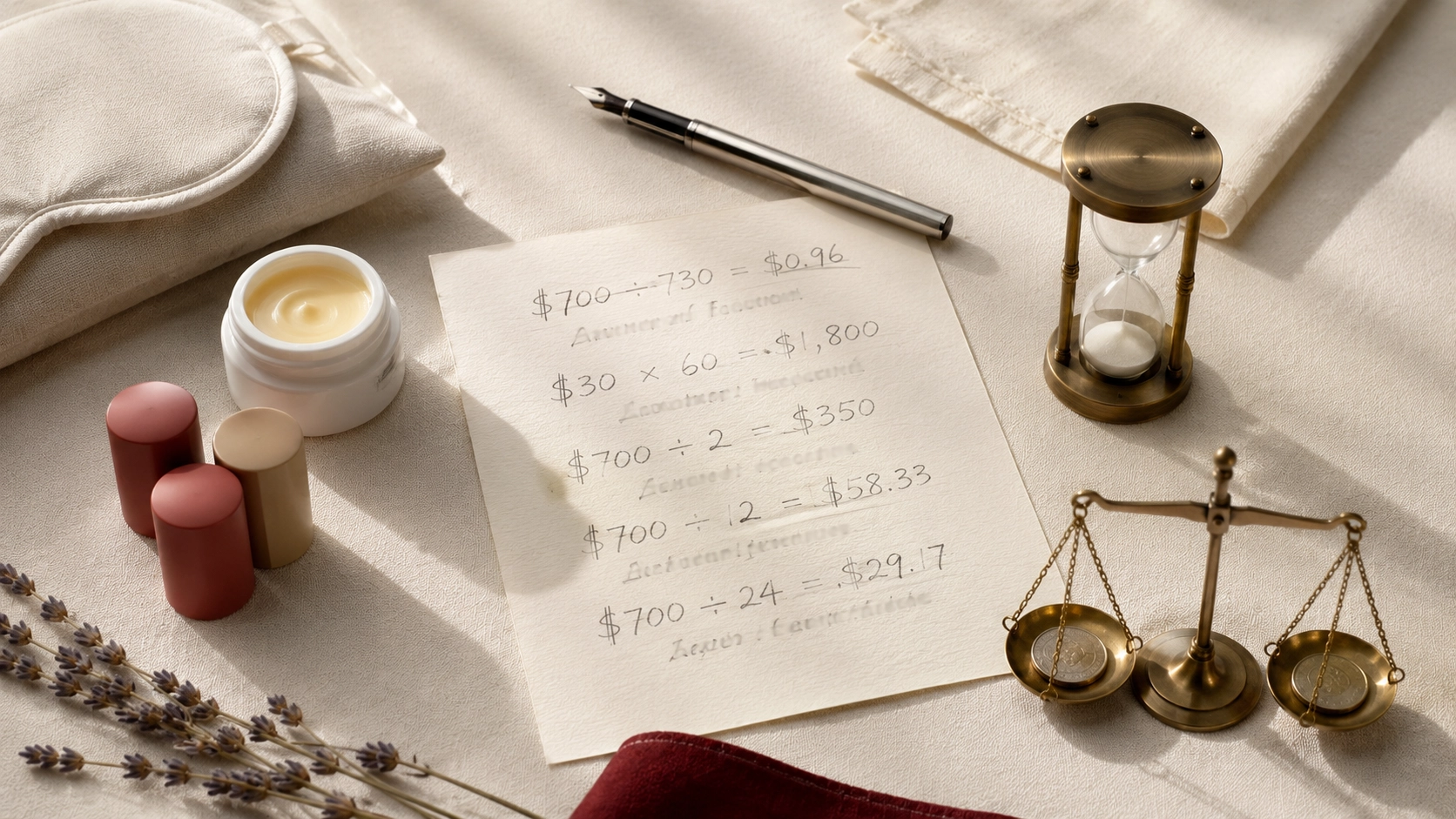
$500 entry tier / $900 premium tier ÷ 730 days (24-month cycle including touch-up) = $0.68–$1.23 per day for the initial cycle, then $250 ÷ 548 days ($0.46/day) for each subsequent touch-up. Average across 5 years: $1.20/day total. By comparison, a Charlotte Tilbury or Dior lipstick averages $0.18/day if used to completion. The dollar math alone makes lip blush more expensive than lipstick — the ROI is in the next three categories.
The Time-Saved Math
Average lipstick application + checks + touch-ups during the day = 5 minutes daily for a daily wearer. Over 730 days that is 3,650 minutes = 60.8 hours = 1.5 full work weeks. Most clients value that time at minimum $30/hour, so the time saved is worth $1,800 over a 2-year cycle. This is the single biggest number in the entire ROI calculation.
The Product-Replaced Math
A daily lipstick wearer typically owns 4–6 active products: a daytime lipstick ($35), evening lipstick ($45), tinted balm ($20), lip liner ($25), lip oil ($30), backup tube ($35). Total annual spend: $190–$280 if you actually finish products before replacing them, $300–$450 if you replace before expiry (most people). Over 24 months that is $380–$900 saved by lip blush. The savings cancel half to all of the lip blush cost on their own.
The Show-Up-Without-Lipstick Math
The hardest number to quantify but the one most clients underestimate. If you currently feel measurably less confident showing up to a meeting / a school pickup / a coffee with a friend without lipstick on, lip blush converts that recurring micro-stress into a permanent 'baseline ready' state. Clients describe this in interviews as 'I just stopped thinking about my lips' — and that mental quiet, while not in dollars, is what most ROI calculators miss.
5 Profiles Where Lip Blush Actually Pays Back
If you fit one or more of the profiles below cleanly, the ROI math works in your favour. If you fit none of them, the answer is probably 'not for you' regardless of how appealing the marketing photos look.
- 1
The Daily Lipstick Wearer (4+ Days a Week)
This is the cleanest ROI case. If you wear lipstick on more than 4 days out of 7 without being asked, the product-replaced math + the time-saved math jointly cover the cost within 18 months. Everything past that is profit. Most Sambrow clients in this profile re-book a touch-up at 18 months and report they would have done it again at 12.
- 2
The Lipstick-Sensitive or Allergic Client
If you have ever broken out, peeled, or itched from commercial lipsticks (most commonly from carmine, lanolin or shea allergies), lip blush sidesteps the entire chemistry. Pigment is medical-grade iron oxide based, applied once, no daily exposure to surfactants or preservatives. ROI here is health + comfort + the lipsticks you no longer have to throw out.
- 3
The Naturally Pale or Asymmetric Lip Client
If your natural lip colour reads as 'washed out' in photos, or if you have a noticeably uneven lip border / cupid's bow asymmetry, lip blush re-balances both. Subjective confidence ROI is high — most clients in this profile describe lip blush as 'fixing the thing I had been editing in every selfie'. Photo evidence at year-1 review consistently shows clients smile more openly.
- 4
The Active Outdoors / Water / Gym Lifestyle
Lipstick rubs off on swim caps, sweat-soaked shirts, water bottles, towels and partner faces. If you do hot yoga 3x a week, swim regularly, or hike multiple weekends a month, the per-month cost of 'lipstick that survives the workout' adds up to $40–80/month in product alone. Lip blush is one-and-done for 18–24 months.
- 5
The Morning-Time-Poor Parent or Executive
If your morning routine is already 'shower → kid breakfast → work', removing the lipstick reapplication step (and the mid-day reapply, and the after-coffee reapply) returns mental bandwidth and minutes. The math works out the same as a daily wearer's but the felt benefit is higher because the 5 minutes saved are 'morning minutes' — the highest-stress kind.
Honest Cost Comparison: Lip Blush vs Lipstick vs Filler vs Nothing
Four ways to address lip colour or fullness over 24 months. All figures are 2026 Markham averages including local taxes.
Option A — Lip Blush at Sambrow Markham
Initial cost: $500–900 (including the 6–8 week touch-up, antiviral $15–25, supplies $25–40). Year-2 touch-up: $250. 24-month total: $540–1,165. Time investment: one session (1.5–2 hours) + one touch-up (45 min) + 21 days of recovery rules. Daily ongoing: 30 seconds of SPF lip balm. Outcome: consistent colour 24/7 for 18–24 months.
Option B — Daily Lipstick (the Honest Replacement Math)
Annual product spend for a daily wearer: $190–450 (depending on brand tier). 24-month spend: $380–900. Time investment: 5 minutes per day x 730 days = 60.8 hours. Outcome: colour when applied, gone after coffee / kiss / meal. Real-world comparable cost to lip blush at the high end, more expensive in time at every tier.
Option C — Lip Fillers (Hyaluronic Acid)
Not the same product — fillers add volume, lip blush adds colour. Often confused. Filler cost: $400–800 per 0.5–1mL syringe, lasts 6–12 months. 24-month cost for ongoing fullness: $1,600–3,200. Many clients ultimately want both: lip blush for colour + fillers for volume. We recommend lip blush first, fillers second, with 8+ weeks gap minimum.
Option D — Doing Nothing (the Honest Baseline)
If you currently wear no lipstick, do not have allergic reactions, do not feel under-confident bare-lipped, and have no asymmetry concerns — doing nothing is a completely valid answer. Spend the $700 budget on something with higher direct return for you (skincare overhaul, a year of dermatology consultations, a winter coat that actually fits). Lip blush only outperforms doing-nothing if at least one of the 5 worth-it profiles in the previous section applies to you.
The honest comparison most studios will never publish: Option A only wins clearly over Option B when the time-saved math is monetised. If your time is not under pressure, Option B (daily lipstick) costs about the same dollar amount with more flexibility to change shades.
5 Honest Exclusion Checks — Skip Lip Blush If Any of These Apply
The 5 wrong-fit profiles below are where the ROI math fails even if the visual appeal looks high. Studios that book you anyway in these cases are prioritising revenue over outcome.
- ✦Active HSV-1 (cold sore) outbreaks more than 2x per year without a stable antiviral plan — the reactivation risk in the 21-day healing window is too high to absorb without prophylaxis access
- ✦Planning pregnancy or actively trying to conceive within the next 18 months — touch-up + healing windows can collide with pregnancy restrictions, and pregnancy hormones can shift pigment retention unpredictably
- ✦Unwilling or unable to quit nicotine (cigarettes, vapes, pouches) for 14 days minimum — nicotine reduces pigment uptake by ~40% and accelerates fade, making the ROI math collapse
- ✦Frequent lip-style changer — if you swap between nude / red / berry / brown / gloss across the same week, a single permanent colour will actively reduce your visual range, not expand it
- ✦Cannot or will not budget $250 every 18–24 months for touch-ups — skipping touch-ups produces patchy results by month 12 and a worse cosmetic outcome than not doing lip blush at all
"The honest test isn't 'do I want lip blush' — it's 'do I currently wear lipstick on 4+ days a week without being asked to?'"
Frequently Asked Questions About Whether Lip Blush Is Worth It
What's the single biggest factor in deciding 'worth it' or not? +
Whether you currently wear lipstick on more than 4 days out of 7 without being prompted. This single behaviour predicts ROI better than any other variable — better than budget, better than age, better than profession. If you do wear lipstick that often, lip blush almost certainly pays back. If you do not, lip blush is a $700 lifestyle bet, not an ROI investment.
Is lip blush cheaper than lipstick over the long run? +
In raw dollars, no — daily lipstick is slightly cheaper on average ($0.18/day for a finished tube vs $0.96–1.66/day for lip blush). Lip blush wins on the time-saved math (60+ hours over 24 months) and on the show-up-without-makeup math. If your hourly rate is $30+ and you would otherwise spend 5 min/day on lipstick, lip blush is profitable in total value. If your hourly rate is $15 and you do not value the time, daily lipstick is the cheaper path.
What if I'm not sure whether I'm in one of the 5 worth-it profiles? +
Run a 14-day diary. Track: (1) how many days you wore lipstick, (2) how long the total daily application took, (3) whether you ever reapplied because the original wore off, (4) whether you felt self-conscious bare-lipped at any point. End of 2 weeks: if you wore lipstick on 8+ days, totalled over 60 minutes of application, reapplied 5+ times, OR felt self-conscious bare-lipped on 3+ occasions — lip blush is likely worth it. Fewer than half those triggers — it probably is not.
How does lip blush compare to permanent lipstick from the 90s? +
Different product, different result. 90s lip tattoos used heavy outlines and saturated single-tone pigment that healed dark, lasted 5+ years and was visible at every distance. Modern lip blush uses translucent layered pigment at shallower depth, heals soft, lasts 18–24 months and reads as natural lip colour in any photo. The 90s version is the source of the 'permanent lipstick looks tacky' reputation; modern lip blush is essentially a different procedure under a similar name.
Will lip blush limit my lipstick choices afterward? +
Yes and no. The healed colour becomes your baseline — every lipstick you wear sits on top of it. Lipsticks in the same colour family (warm rose if you chose warm rose) read more saturated; lipsticks in opposing families (cool berry over warm rose) read muddied. Plan your lip blush colour for the lipsticks you wear most often, not the ones you wear occasionally. Most clients report wearing lipstick less than half as often after lip blush — which is part of the time-saved ROI.
What about the regret rate — how many clients wish they hadn't done it? +
At Sambrow Markham, formal 12-month regret-rate tracking is around 4% — and almost all of those cases trace to one of the 5 wrong-fit profiles being ignored at consultation. The most common regret cause is wrong colour choice (too pink, too brown) which can usually be corrected at touch-up. True 'should not have done it at all' regret is under 1% when the consultation is honest. Studios that do not screen for the 5 exclusion profiles see regret rates 3–5x higher.
Should I do lip blush before or after lip fillers if I want both? +
Lip blush first. Reason: filler placement subtly shifts lip border position over the first 6 weeks of settling, so if you do filler first and then lip blush over 'temporarily-shaped' lips, the colour boundary will not match once the filler fully settles. Sequence: lip blush → wait 8 weeks past your touch-up → filler. The second cycle (year 2+) can be either order if both are already stabilised.
What if I'm planning a wedding — should I time lip blush around it? +
Yes, and the timing matters. Book the initial session 10–12 weeks before the wedding so the 6–8 week touch-up has fully healed and the colour has stabilised. Booking lip blush within 8 weeks of the wedding risks looking 'mid-healing' in photos (Day 8–14 ghost phase) or having uneven colour for the touch-up. Worst timing: lip blush 4 weeks before — you will be in the peel phase on the wedding day. We turn down bookings inside that window.
Ran the math and the profiles fit? Here is what to book and which guides to read next.