Sambrow Journal · Markham
Microblading vs Powder Brows: A Technique-Level Breakdown
Needles, depth, dispersion — the engineering view, by Sam Liang
TL;DR
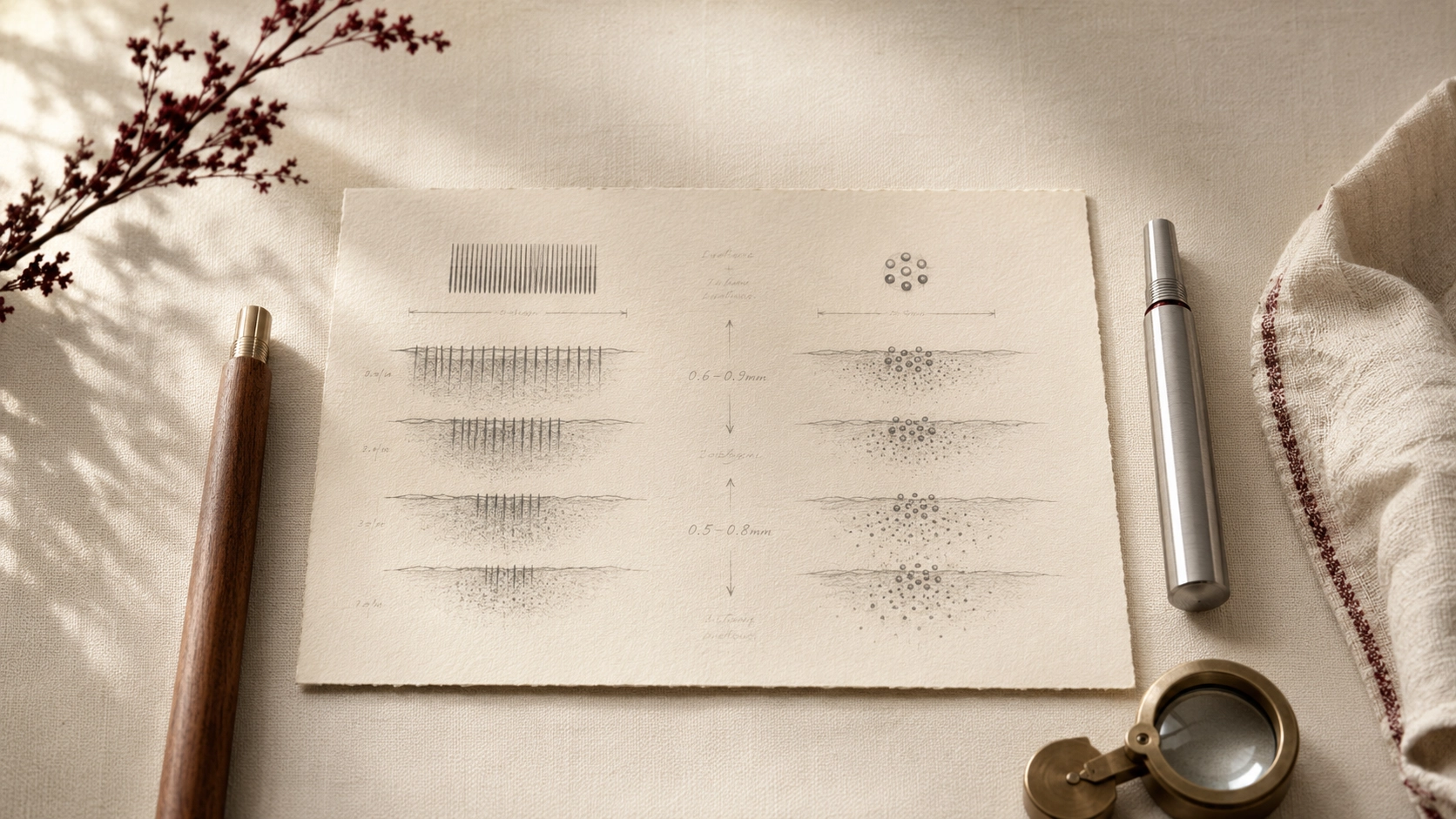
This is the technique-focused comparison — not 'which suits you' (covered in the ombre vs microblading decision tree), but 'what is actually happening on your skin'. Microblading uses a manual blade with 7–14 fine needles arranged in a line, creating individual incisions where pigment is deposited as discrete linear strokes at 0.6–0.9mm depth. Powder brows uses a machine-driven rotary needle (3–5 needles in a cluster) tapping at 80–120 Hz, dispersing pigment in micro-dot patterns at 0.5–0.8mm depth. Both reach the epidermal-dermal junction; both use the same iron-oxide pigments. The healed result differs because the placement pattern differs — strokes vs dots — not because the chemistry differs. Understanding this matters because it explains why oily skin blurs microblading (linear strokes diffuse) but holds powder brows (dot patterns reinforce each other).
Microblading — Manual Linear Strokes
Hand-tool, blade-shaped needle cluster, individual hair-like incisions
- Best for
- Dry-to-normal skin, clients wanting visible hair-stroke detail at close range
- Duration
- 12–18 months retention
- Comfort
- 3–4 / 10 — sharper sensation from blade design
- Finish
- Individual visible strokes mimicking real brow hairs
Pros
- + Highest realism at conversation distance (under 60cm)
- + Most precise control of individual hair direction (artist can match real brow flow)
- + Shorter session — 90–120 min total
- + Visible 'starting' result on Day 1 because strokes are placed individually
Cons
- − Manual depth control is harder — higher scarring risk with under-trained artist
- − On oily skin: linear strokes diffuse laterally during healing — blurs by month 6
- − Cannot reliably cover a previous powder brow without lightening first
- − Each session retouches fewer strokes (more session-by-session evolution)
Powder Brows — Machine Dot Pattern
Rotary machine, fine needle cluster, dispersed micro-dot shading
- Best for
- Oily skin, all ages, clients wanting density-over-detail
- Duration
- 18–22 months retention
- Comfort
- 3 / 10 — smoother vibration sensation
- Finish
- Soft powdered shading — denser at tail, lighter at front
Pros
- + Machine depth precision — lower scarring risk
- + Dot pattern reinforces in oily skin — best retention category for oily clients
- + Can layer over previously microbladed brows for refresh
- + Day 1 looks more 'finished' (no stroke-pattern uncertainty)
Cons
- − Less close-range hair-stroke realism (powdered look at < 30cm)
- − Longer session — 120–150 min total
- − Initial result looks more 'made-up' until softens at week 4
- − Slightly higher pigment volume used (about 10–15% more) — minor cost factor
Technique Comparison
| Microblading — Manual Linear Strokes | Powder Brows — Machine Dot Pattern | |
|---|---|---|
| Tool type | Manual blade | Rotary machine |
| Needle configuration | 7–14 needles in line | 3–5 needles in cluster |
| Operating frequency | Hand-paced (variable) | 80–120 Hz |
| Placement depth | 0.6–0.9mm | 0.5–0.8mm |
| Pigment dispersion pattern | Linear strokes | Micro-dot pattern |
| Markham price (incl. touch-up) | $450–650 | $500–700 |
| Session time | 90–120 min | 120–150 min |
| Pain sensation | 3–4 / 10 (sharper) | 3 / 10 (vibration) |
| Best skin type | Dry to normal | Oily; works on all |
| Retention | 12–18 months | 18–22 months |
| Scarring risk | Higher (manual) | Lower (machine) |
How to Choose at the Technique Level
Choose Pick Microblading
If close-range hair-stroke realism is your #1 priority AND your skin is dry-to-normal AND you accept the 12–18 month retention as part of the deal. Microblading is the right answer about 35% of the time in Markham consultations — usually clients in their 20s–30s with naturally sparse brows wanting visible 'extra hairs' added to existing structure.
Choose Pick Powder Brows
If your skin is oily, if you are 40+, if density is more important than close-range hair detail, or if you want maximum retention. Powder brows is the right answer about 50% of the time — and is the default recommendation when skin type test is borderline.
Choose Consider a Combo Approach
If you want both detail at the front and density in the body, combo brows (microblading strokes at the front 1/3, powder shading in the body and tail 2/3) handles both — $700–900 in Markham. Best for normal-to-slightly-dry clients. Discussed in detail under combo brows in the brow services hub.
Frequently Asked Questions About the Two Techniques
Why do microblading strokes blur on oily skin specifically? +
Sebum production in oily skin creates an under-skin environment where pigment particles dissolve laterally over time. Linear stroke patterns lose definition first because adjacent strokes blend into each other (lateral diffusion of 0.1mm is invisible on dot patterns but visible on strokes). Powder brows dot patterns reinforce because the dots are arranged in dispersed micro-clusters — diffusion of any single dot is absorbed by the cluster average. This is empirically documented across thousands of healed cases.
Is one technique 'safer' than the other? +
Both have similar safety profiles when performed by trained artists in compliant studios. The technique-level distinction: microblading has higher scarring potential because manual depth control is harder; powder brows has lower scarring potential because machine depth is mechanically constrained. Both have effectively zero infection risk at compliant studios. Choose by suitability, not safety — the safety floor is the same.
Does one technique fade more evenly than the other? +
Yes — powder brows fades more evenly. Dot patterns lose density uniformly across the brow. Microblading strokes can fade unevenly because individual strokes may retain different amounts based on depth variation across the session. This is one of the reasons powder brows clients tend to delay touch-ups longer — the fading is less noticeable visually.
Can I tell from a healed photo which technique was used? +
At distance, often not — both look like 'nice brows'. Up close (within 30cm), microblading shows individual hair-strokes you can count; powder brows shows a soft powdered gradient. After 12 months, both can look similar at any distance as strokes soften and dots blend. Most clients cannot reliably tell the difference in their own healed brows at month 12+.
Are there hybrid technique variations? +
Yes — nano hair-stroke (machine + ultra-fine needle producing strokes mechanically) bridges microblading aesthetics with powder brows safety profile. Combo brows uses both techniques in one session in different brow zones. Both are mid-tier price ($600–900) and discussed in detail in the nano vs powder vs ombre 3-way guide.
Does the artist's skill matter more for one technique than the other? +
Microblading skill curve is steeper because manual depth control + stroke design + hair-direction matching are all judgment calls. Powder brows has more machine-supported precision but artistic skill remains critical for shading gradient and overall brow design. Top artists in both produce excellent results; mediocre artists produce notably worse microblading than mediocre powder brows. If unsure about artist experience, powder brows is the safer choice.
Why does powder brows take longer if the machine is faster? +
The machine operates faster, but the total area covered is larger — powder brows shades the full brow surface while microblading only places individual strokes. Coverage time × stroke density determines session duration, not raw needle speed. A complex combo brow with both techniques can run 150+ minutes.
Which technique is better for very sparse natural brows? +
Powder brows or combo brows — microblading needs underlying brow structure to look natural. On very sparse brows microblading strokes appear isolated rather than integrated with real hairs. Powder brows fills the full area regardless of underlying density. For maximum naturalness on sparse brows, combo (microblading at the front edge for direction + powder fill across the body) is the best of both.
Pick your technique, or step back to the lifestyle-based decision tree.