Sambrow Journal · Markham
Best Brows for Asian Face Shapes: 10 Design Considerations Most Stylists Miss
Monolid, arch placement, hair colour balance, cultural range — by Sam Liang
TL;DR
Asian face shapes — including East Asian (Chinese, Korean, Japanese, Vietnamese), South Asian, and Southeast Asian — have anatomical and stylistic considerations that generic 'best brow shape' guides miss. The 10 factors below cover: brow bone prominence (often flatter than European faces), monolid / single-eyelid considerations, lower-set arch placement, dark hair colour pigment matching (avoiding warm-red oxidation), cultural style range (Tokyo soft, Korean straight, Chinese arched), and Markham-specific demographic preferences that have shifted in 2025–2026. Skipping these factors is why generic brow templates produce results that look 'right' on European faces and 'off' on Asian faces. None of this is preference — it is anatomical fit.
Most international brow guides default to European face anatomy: prominent brow bone, deeper-set eye sockets, lighter hair colour pigment range. Asian face shapes share none of these defaults — and getting the design wrong by 2–3mm in arch placement or by 1 shade in pigment selection produces a result that reads 'off' even when the work itself is technically excellent. This guide is the 10-factor anatomical and stylistic checklist specifically for Asian face shapes in Markham 2026. Bring it to your consultation; ask the artist to discuss each factor. Their answers signal whether they have actually worked with Asian clients beyond a few.
- 1
Brow Bone Prominence Differs from European Standard Templates
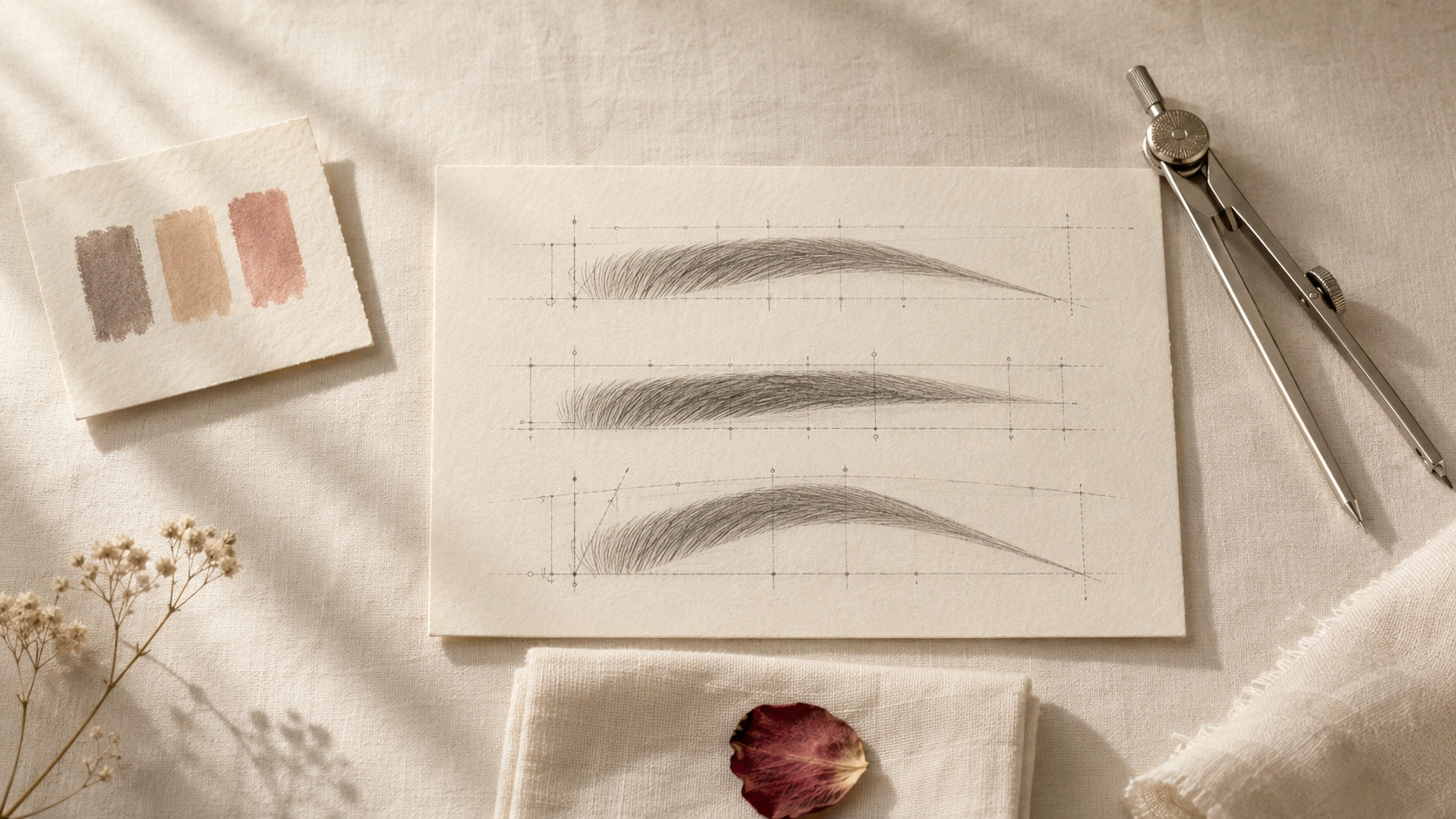
East Asian and Southeast Asian face shapes typically have a flatter brow bone (less protrusion above the eye socket) than European faces. The standard 'high arch + dramatic tail' brow template designed for European bone structure looks unnaturally lifted on flatter brow bones — like the brow is detached from the face. The correct Asian face arch is 30–40% softer in height and placed 2–3mm lower than European templates. Ask your artist to show before / after photos of Asian clients specifically — generic portfolio Asian-face proportions matter.
Lower, softer arch reads natural on Asian face shapes. High dramatic arch reads 'European template applied'.
- 2
Monolid / Single-Eyelid Adjustment — Brow Position Closer to Lash Line
For monolid clients (single eyelid, no visible crease), the brow needs to sit closer to the lash line than for double-lid clients — typically 3–5mm closer. This visually shortens the space between brow and lash line, which on monolid faces otherwise reads as elongated. Generic brow templates that assume a visible crease place brows too high, creating a 'distant' look. Microblading and ombre artists who have worked on diverse Asian eye shapes know to adjust this; those who have not place brows by European geometry. Specific question to ask: 'how do you adjust for monolid vs double-lid clients?'
Monolid faces need brows 3–5mm closer to lash line than double-lid templates.
- 3
Arch Apex Position — Slightly Inward of European Templates
The arch apex (highest point of the brow) sits at approximately 2/3 the brow length on European templates. On Asian face shapes, the apex naturally reads better at 60–65% — slightly inward. The 2mm difference is invisible on a sketch but the difference between 'looks like my face' and 'looks like someone else's face on me' is in this 2mm. Combined with the lower-overall arch from factor #1, this produces the soft 'natural enhancement' Asian clients usually want — not the dramatic arch standard in European tutorials.
- 4
Pigment Selection — Cool-Brown Base, Not Warm-Red
Asian hair is most commonly a cool-brown to black with cool undertones. Brow pigments designed for European hair (warm reddish-brown base) heal warm — and on Asian face undertones can read orange or red after Week 6. The correct pigment base for most Asian clients is cool-brown or black-brown with green or violet shadow modifiers, NOT the standard warm-rose mix. Specific brand guidance: Permablend Asia line, Tina Davies 'I Love Ink' Brown 4 or 5, Li Pigments Onyx. Studios that use only one default pigment regardless of client are producing healed warm-red brows on Asian faces — a 6-month problem when it surfaces.
- 5
Style Range — Tokyo Soft, Korean Straight, Chinese Arched
Asian brow aesthetics span at least 3 distinct contemporary styles, each suiting different face types and cultural preferences. Tokyo soft: very low-contrast, almost no defined arch, soft front-to-tail gradient, suits very symmetrical faces. Korean straight: minimal arch, near-horizontal line, defined edges, suits softer round faces. Chinese arched (peony style): gentle defined arch with longer tail, suits oval / heart face shapes. None is more 'authentic' than another — they reflect contemporary preferences across different cultural centres. Discuss which style group fits your face during consultation.
- 6
Skin Undertone — Most Asian Skin Has Yellow-Olive Undertone (Not 'Warm' or 'Cool')
Standard cosmetic colour theory categorises skin as warm or cool. Asian skin often falls outside this binary, in a yellow-olive zone where standard warm pigments heal too red and standard cool pigments heal too grey. The correct approach is neutralisation: a pigment with balanced warm-cool components plus a slight olive-modifier counters the underlying skin tone. Specific test: hold a swatch against your inner wrist in window light — if it reads orange against your skin, the pigment will heal too warm on you. Ask the artist to test 3 swatches and discuss undertone fit before approving.
- 7
Hair-Stroke Direction — Asian Brow Hair Often Grows Downward at Front
On many Asian faces, the brow hair at the front (closest to the nose bridge) naturally grows downward rather than upward as in European templates. Microblading or nano hair-stroke designed in the European upward-front pattern looks visually unnatural on Asian faces because it contradicts the underlying hair direction. The correct technique: mirror the natural growth pattern — downward strokes at the front, transitioning to outward strokes through the body and tail. If your artist has only worked with European templates, this nuance is often missed.
- 8
Face Shape Considerations — Asian Round Face Needs Different Treatment Than Asian Oval
Round Asian face (common in younger demographics): needs slightly elongated brow with subtle arch to add length. Oval Asian face: a balanced soft arch with proportional length. Heart-shaped Asian face: lower arch, slightly shorter tail to avoid drawing attention upward. Square Asian face: softer rounded brow shape to balance angular jaw. Generic 'best brow for round face' guides apply approximately, but the specific proportions differ from European references — typical Asian face measurements are narrower at the temple and require different brow-to-face ratios.
- 9
Asymmetry Tolerance — Asian Faces Often Show Eye Asymmetry as Visible Variation
Eye asymmetry (one eye slightly higher, slightly larger, or with a different crease pattern) is common across all face shapes but tends to read more visibly on Asian faces because of the typically lower brow position — the brow sits closer to the asymmetry. A skilled brow artist measures both sides separately and designs asymmetrical brows that LOOK symmetrical (typically requires 1–2mm difference in arch placement between sides). Generic 'apply the same template to both sides' approaches produce visually asymmetric results on naturally asymmetric faces.
- 10
Trend Awareness — Markham 2025–2026 Has Shifted to Softer, Natural Styles
The bold defined brow trend (2017–2021) has been replaced in Markham's primarily East Asian demographic by softer, more natural styles. Korean glass-skin influencer aesthetic emphasises minimal brow makeup; Tokyo soft brows favour barely-visible enhancement. Chinese contemporary aesthetics span a wider range but trend toward softer than 5 years ago. Your artist should ask which contemporary reference you have in mind (Korean / Tokyo / Chinese contemporary) before designing. Studios stuck in the 2019 bold-brow template are producing results that read as dated to current clients.
Asian face brow design is not 'European brows on Asian skin' — it is a different starting set of anatomical proportions, hair colour pigments, cultural style range, and undertone management. The 10 factors above are the consultation checklist; bring them to your booking. Studios that can answer all 10 with specifics have actual experience with Asian clients. Studios that respond with 'we use the same approach for everyone' are not the right fit, regardless of price tier or marketing photos. At Sambrow Markham our bilingual consultation includes all 10 factors as standard.
Frequently Asked Questions About Brows for Asian Face Shapes
My natural brows are very sparse — does that change the design considerations? +
It changes execution more than design philosophy. Very sparse Asian brows benefit from combo brow techniques (microblading at the front for direction + powder shading through the body for density) more than either single technique. The arch placement and pigment selection considerations remain identical to dense-brow clients.
Can I bring K-pop or J-pop celebrity photos as reference? +
Yes, with realistic expectations. Celebrity brows are often professionally trimmed, dyed, and shaped daily by stylists — bring them as style reference (Korean straight, Tokyo soft, Chinese contemporary), not as exact replication target. Your face shape, brow bone, and natural hair pattern are different from any celebrity's, and the design should suit your anatomy. A good artist takes the style direction and adapts.
Should I tell the artist what country I'm from or what my heritage is? +
Useful context but not the determining factor. Heritage gives a general anatomical hint (East Asian, South Asian, Southeast Asian have somewhat different average proportions), but individual face anatomy varies widely within any heritage group. The artist should measure and design based on your specific face, not assumptions from your heritage. If the artist designs primarily by heritage label, that signals limited individualised assessment.
What about mixed heritage faces? +
Most face anatomy follows a continuum rather than discrete categories. Mixed-heritage clients are evaluated by individual measurements — brow bone height, eye crease pattern, face shape, skin undertone — rather than by background. The 10-factor checklist applies regardless of heritage proportions; specific measurements and pigment matches are tailored to each face individually.
How do I find a Markham artist with Asian face experience? +
Three indicators: (1) portfolio shows 20+ healed photos at 4+ weeks of clients with diverse Asian face types, (2) artist can name specific pigments suited to cool-undertone skin without prompting, (3) consultation discusses arch position and brow position specifically rather than 'standard'. Bilingual EN/Mandarin consultations are an additional positive indicator (suggests demographic familiarity).
Do older Asian women need different brow design than younger? +
Yes — and this is the area where Asian face design most commonly goes wrong. Aging eyelid skin (Asian or otherwise) drops the eye-to-brow distance by 1–2mm per decade after age 40, which means brow position designed for a 30-year-old face will read 'too high' by age 50. Maintenance touch-ups at 18–24 months should reassess position, not just replicate the original design. Many older clients reporting 'my brows look strange now' actually have unchanged brows on changed faces.
What's the most common mistake on Asian-face brow design that you see? +
Pigment selection — using a warm-brown European default that heals red-orange on Asian undertones by Week 6. Second most common: arch placed too high (the European template). Third: hair-stroke direction reversed at the front (upward when it should be downward). All three are correctable at touch-up if caught early; all three are why first-timer Asian clients often dislike their initial result for 6–8 weeks before the touch-up adjusts.
Are there any styles I should avoid as an Asian client? +
Three: (1) very high dramatic arches (originally a European glamour template), (2) overly straight Korean-2018 style if you have a round face shape (emphasises roundness), (3) sharp angular tails (looks harsh on softer Asian face features). None is forbidden, but each carries higher 'looks wrong on my face' risk if your specific anatomy does not suit. A good consultation flags this risk before committing.
Asian-face-fit consultation in Markham — bilingual and demographically experienced.