Sambrow Journal · Markham
How to Choose a Permanent Makeup Artist in Markham: 9 Vetting Checklist Items
What to verify before paying any deposit — by Sam Liang
TL;DR
Choosing an SPM artist in Markham involves checking 9 specific items. Skipping any one is the leading cause of regret cases we see at correction consultations. The checklist covers premises licensing, portfolio depth (healed photos not Day 1), sterile single-use needle protocol, pigment brand transparency, structured medical screening, written touch-up policy, correction / refund policy in writing, demonstrated category-specific experience, and bilingual / cultural fit if relevant. None of these requires special expertise — they require asking direct questions and getting direct answers. Studios that bristle at any of the 9 items are signalling something about their operations. Use the checklist; book the artist who passes all 9.
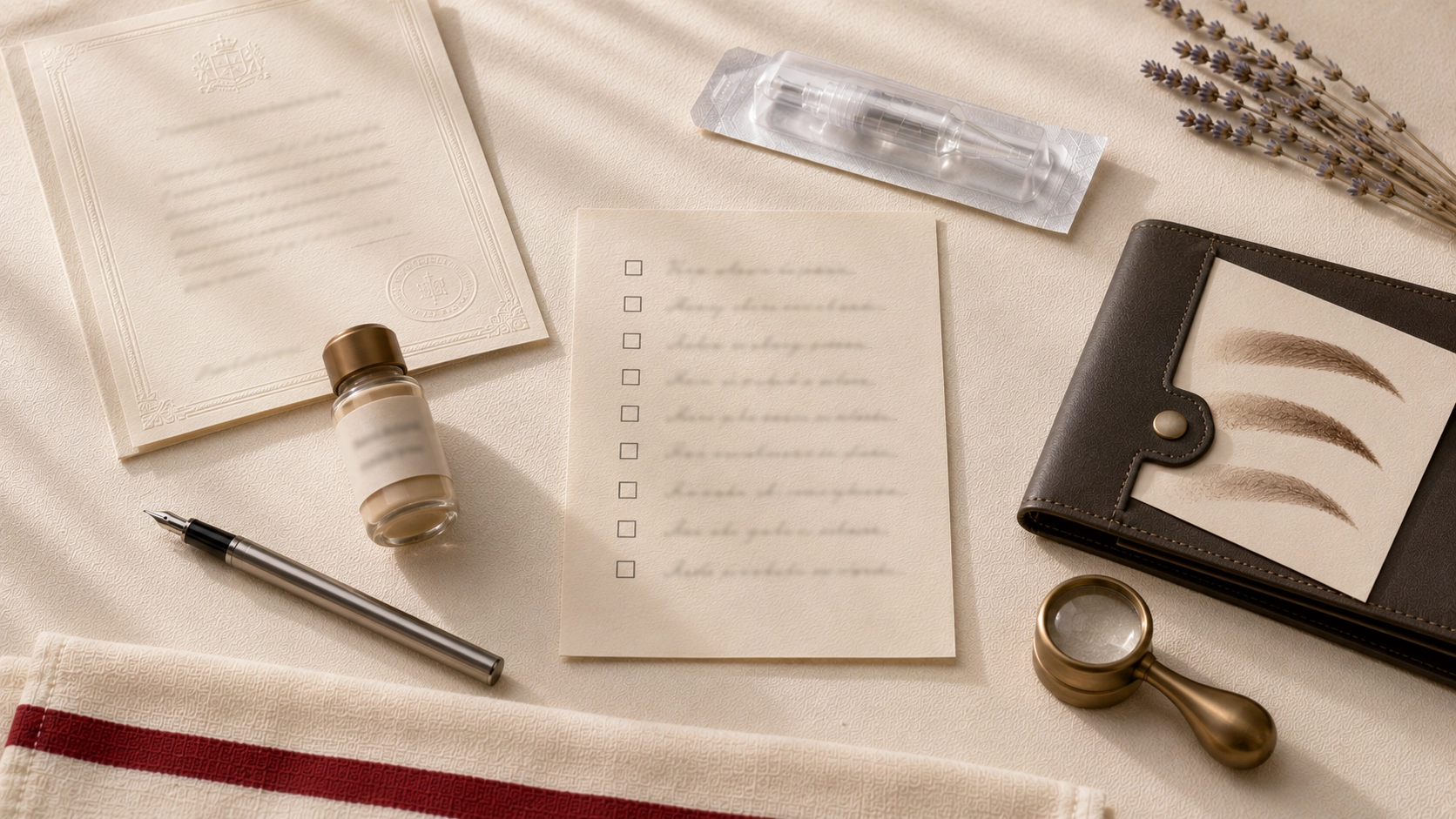
This is the final guide in the Sambrow Markham 24-piece SPM blog series — and the one that should come first if you have not booked yet. The 9 items below are the entire vetting checklist; they take 30 minutes to verify across consultation calls or in-person visits. The cost of vetting (your time) is minimal; the cost of skipping vetting (correction work, regret, sometimes medical complications) is significant. Print this page, take it to consultations, ask each item directly. The right artist passes all 9 with specifics. The wrong artist deflects on at least one.
- 1
Item 1 — Verify Ontario Premises Licence Number (PSS Database Lookup)
Every permanent makeup studio in Markham must hold a current Personal Service Settings (PSS) premises licence under the Health Protection and Promotion Act. The licence number is required to be displayed in the studio. Verification: ask to see the licence, write down the number, and check it on York Region Public Health's public PSS inspection database before paying any deposit. Recent inspections and any violations are public record. If the studio claims 'we are in renewal' or 'the licence is at the head office', book elsewhere — both are common cover responses for not holding a current licence.
Licence number + PSS database lookup — takes 5 minutes, eliminates 80% of unsafe studios.
- 2
Item 2 — Request 20+ Healed Photos at 4+ Weeks Post-Procedure
Day 1 photos look saturated and impressive but tell you nothing about healed quality. Real evaluation requires Week 4+ photos from the artist's own work, ideally taken in natural light, ideally showing clients with skin tones and face types similar to yours. If the portfolio is mostly Day 1, mostly Instagram-filtered, or 'mostly our trainer's', the artist either lacks experience or is hiding actual outcomes. Ask specifically: 'can I see 5 healed Week 6 photos of Asian / olive / dark / hooded / monolid (whatever applies to you) clients?'
Healed Week 4+ portfolio in your specific demographic — non-negotiable evidence.
- 3
Item 3 — Watch the Sterile Needle Cartridge Be Opened in Front of You
All needles must be sealed sterile single-use units, opened in your presence at the start of each session. CSA Group certification is the Canadian standard. If the answer involves the needle 'already being ready' or 'just opened it before you came in' or 'we autoclave between clients', book elsewhere. This is the single largest infection-control standard; verifiable in real-time with no specialised knowledge.
Watch the unsealing. If it happened before you arrived, you cannot verify it.
- 4
Item 4 — Confirm the Pigment Brand and Specific Colour Name
Reputable brands publish full ingredient lists, MSDS sheets, and lot numbers. Names you can verify: Permablend, Tina Davies, Li Pigments, Perma Blend Luxe. Generic 'our own brand' or 'standard mix' answers indicate unbranded pigment of unknown origin — which can contain ingredients not approved by Health Canada. Google the brand name during the consultation; reputable brands have public ingredient disclosure within the first search result. Studios that cannot name the brand are using something they should not.
Specific brand name + ingredient disclosure searchable on Google in 60 seconds.
- 5
Item 5 — Structured Medical Screening Conversation
Before any deposit, the consultation should include a structured conversation covering at least 5 of the 10 contraindication categories (pregnancy, active eye / lip infection, recent eye surgery, autoimmune flare, blood thinners, chemo, Accutane, keloid history, ophthalmic shingles, uncontrolled diabetes). Should also ask for medication list, recent surgeries, and known allergies. If the screening is 'are you pregnant?' followed by 'okay let's start', the screening is not real — and missing a contraindication is the leading cause of preventable complications.
5+ contraindication categories asked about = real screening. 1 category = theatrical screening.
- 6
Item 6 — Touch-Up Policy in Writing on the Invoice
The 6–8 week touch-up is industry-standard at mid-tier ($400–950) Markham pricing. Studios at this tier that exclude the touch-up are quietly charging $400+ for what is actually a $250–350 partial service. Verification: ask 'is the touch-up included in the quoted price?' and require the answer in writing on the invoice or contract. Verbal yes without written confirmation is not enough. Studios that decline to put it in writing should be filtered out at the booking call.
Written touch-up inclusion on the invoice = signed commitment. Verbal yes = no commitment.
- 7
Item 7 — Correction / Refund Policy in Writing
Mid-tier and premium studios should have a written correction policy. Ask Sambrow for the current written correction and follow-up terms; do not assume correction work is included; if the unhappiness is structural (shape, placement) significant correction is discussed individually. Studios with no written policy are typically the ones where correction becomes 'pay full price for another session' — verify before booking, not after.
- 8
Item 8 — Category-Specific Experience (Last 12 Months)
Different SPM categories require different skill sets. Microblading on Asian face shapes, lower lash eyeliner, lip blush colour theory — each is its own sub-specialty. Ask specifically: 'how many [your category] sessions have you done in the past 12 months?' Acceptable answers for safety: 50+. Excellent answers: 200+. Below 25 in 12 months suggests low practice volume; below 10 is concerning. The honest follow-up: ask to see 10 healed photos specifically from those sessions.
- 9
Item 9 — Bilingual / Cultural Fit (If Relevant)
For Markham's diverse demographic, bilingual capability (English + Mandarin, Cantonese, Korean, Tamil, Hindi as relevant) significantly improves consultation accuracy and aftercare comprehension. Cultural familiarity (knowing why certain face proportions look 'right' or 'wrong' across different heritages) is a meaningful skill that comes from working with diverse clients. If you have a heritage-specific aesthetic in mind, the right artist has examples from that demographic in their healed portfolio.
Bilingual EN/Mandarin and visible Asian-face healed portfolio = demographic-fit signal for Markham's primary client base.
Vetting an SPM artist in Markham takes 30 minutes of direct questioning and 5 minutes of online verification. The cost of vetting is your time; the cost of skipping vetting is correction work, regret, and occasionally medical complications. The 9 items above are the complete checklist. Right artists pass all 9 with specifics, in writing, with portfolio evidence. Wrong artists deflect on at least one. There is no halfway in this checklist — items 1, 3, 4, and 5 are particularly non-negotiable. If you read this far in the Sambrow blog series and remember only one thing: ask all 9. The answer pattern across them tells you everything you need.
Frequently Asked Questions About Choosing an SPM Artist
How many studios should I consult before deciding? +
Three is a reasonable target. One studio: not enough data to identify what 'normal' answers look like. Two studios: better, but still subject to halo effects from the first impression. Three studios: you start seeing the pattern — which questions are answered identically (industry baseline) and where studios differ (true differentiators). Stop at three; more becomes diminishing return.
What's the single biggest red flag in an SPM consultation? +
Reluctance to put anything in writing — touch-up inclusion, correction policy, pigment brand, sterilisation protocol. Verbal assurance without documentation is the pattern shared by every regret-case we see at correction consultations. If a studio's response to 'can you put that in writing?' is anything other than 'yes', that is the red flag.
Should I choose the cheapest mid-tier studio if all 9 items pass? +
Mid-tier is the right tier for most clients ($400–950 range). Within mid-tier, the differences in price reflect artist seniority and studio environment more than outcome quality. Choose the artist who passes all 9 items AND whose communication style and healing-portfolio aesthetic match what you want. Slight price differences within mid-tier are usually not the deciding factor — fit is.
What if a celebrity / influencer recommends a specific studio? +
Use the recommendation as a starting point, run the 9 items independently. Celebrity recommendations are often paid partnerships or based on different needs than yours. The 9 items work whether the recommendation came from Instagram, a friend, a Google search, or your dermatologist. Don't outsource the vetting.
Can I do all 9 items remotely / by phone? +
Items 1, 2, 4, 6, 7, 8, 9 can be done by phone or email. Items 3 and 5 require in-person (watching needle unsealing) or video call (structured medical screening conversation). Most studios accommodate a 20-minute video consultation before in-person visit; use it. The full in-person consultation is for items requiring physical assessment (face mapping, colour swatching, patch testing if needed).
How do I evaluate the studio environment itself? +
Three observations during the consultation visit: (1) is the work surface visibly clean and well-organised? (2) is there a separate hand-washing station with disposable towels? (3) does the studio smell of any chemical product or only mild cleaning products? Beyond aesthetics, these signal infection-control discipline. A studio that looks cluttered or smells chemical is signalling something about how it operates.
Can I ask to see the artist's certification? +
Yes, and you should. Ontario does not provincially certify individual SPM artists, but reputable artists hold certificates from recognised international training programs (Phibrows, World Microblading Academy, Tina Davies, Daria Chuprys for advanced techniques, etc.). The certificate name + issuing organisation should be Google-verifiable. 'Self-trained' or 'apprenticed informally' is a red flag in 2026 SPM — the field has matured beyond informal training.
What if I have a complicated case (correction, asymmetry, prior bad work)? +
Complicated cases need premium-tier or specialty-tier artists, not mid-tier first-time generalists. Ask specifically: 'do you handle correction work?' and 'show me 5 correction cases you have completed.' If the answer is 'we don't do correction' or the portfolio is empty, the studio is honest about scope — pivot to a different studio that does correction. Specialty correction artists are worth premium tier pricing.
Ready to start? Run the 9-item checklist on your shortlisted studios.