Sambrow Journal · Markham
Permanent Eyeliner Aftercare: 10 Specific Rules (with Brands and Doses) for the 14-Day Window
Not 'use ointment as needed' — the brand-name, milligram, exact-day checklist Markham clients actually follow, by Sam Liang
TL;DR
Permanent eyeliner aftercare is mostly vague online — avoid moisture, use healing balm. This is the version with specifics. The 14-day window has 10 non-negotiable rules: blot-don't-wipe for the first 90 minutes, Aquaphor or A&D paper-thin 3x daily (never thicker than 1mm), sterile saline rinse for 7 days (not tap water), back-sleep for 3 nights, Tylenol up to 500mg QID — never Advil, SPF 30+ on the lid from Day 15, brand-new mascara on Day 15, no water on the line for 10 days, caffeine capped at 1 cup and alcohol at zero for 14 days, photo log Day 1/3/7/14/21/28. Total downtime: zero work missed. Supply cost: under $40 CAD if you do not already own Aquaphor, sterile saline, fresh gauze and a clean pillowcase.
If you have already read the day-by-day healing timeline (highly recommended — link at the bottom), this article is the cross-cutting rulebook: 10 specific aftercare decisions you will face during the 14 days, each with a brand name, a number, or a date attached. The reason these matter is plain — vague aftercare advice causes patchy results, and patchy results need a longer touch-up. Take 8 minutes once, save this page, follow the rules — and your touch-up at week 6-8 will be cosmetic-level fine-tuning, not damage control.
- 1
Blot — Don't Wipe — for the First 90 Minutes
After your session, lymph (clear-yellow fluid) will weep slightly. Use sterile gauze (4x4 cm individually-wrapped, available at any Shoppers Drug Mart for about $8 / box of 25). Press straight down for 2 seconds, lift straight up. Never drag sideways — sideways motion smears unset pigment and is the most common Day 1 error. Repeat every 30 minutes for the first 2 hours. After hour 2 weeping stops and you can switch to the ointment routine in Rule 2.
Press, lift, never drag. 90 minutes.
- 2
Aquaphor or A&D — Paper-Thin Film, 3x Daily
Two ointments work; everything else does not. Aquaphor Healing Ointment (the original tub, not the lip product) or A&D Ointment Original. Both are at any Canadian pharmacy for $10–14. Apply a film so thin it looks like nothing is on the skin — never thicker than 1mm (about half a grain of rice spread across the entire lash line). Three times daily: morning, mid-afternoon, before bed. Through Day 10. Thick ointment suffocates the wound and traps pigment displacement; correct thickness is almost invisible.
If you can see the ointment, you used too much.
- 3
Sterile Saline for 7 Days — Not Tap Water
Buy single-use 5mL sterile saline ampoules (about $6 for a box of 20 at Costco or any pharmacy — search 'sterile saline single dose'). Twice daily, soak a fresh cotton pad and gently dab the lash line to remove crust or weeping residue. Never use tap water — even filtered tap water contains microbes that are harmless on intact skin but actively risky on a healing wound. Never use micellar water, makeup remover, baby shampoo, or eye drops; all contain preservatives or surfactants that lift pigment.
If it is not labelled 'sterile saline', it does not touch your eyeliner.
- 4
Three Nights on Your Back, Fresh Pillowcase Each Night
Side or stomach sleeping in the first 72 hours is the #1 cause of asymmetric patchy healing — your pillowcase smears unset pigment and absorbs the ointment film. Sleep on your back, head slightly elevated with one extra pillow (the elevation alone reduces overnight swelling by 30–40%). Fresh pillowcase every night — bacteria and skin oils accumulate fast. Silk or sateen if you have it; clean cotton if not. From Day 4 you can return to side sleeping with a fresh pillowcase every other night.
The first 3 pillowcases matter more than the first 3 ointments.
- 5
Tylenol Yes, Advil Never — 500mg Up to 4x Daily
If swelling or tightness is uncomfortable in the first 48 hours, acetaminophen (Tylenol) 500mg up to 4 times daily is fine. Do not use ibuprofen (Advil, Motrin), aspirin (ASA), naproxen (Aleve) or any combined cold medicine containing them — all are blood thinners that worsen bruising, dilute topical numbing residue and prolong the lymph weeping window. Stop all anticoagulants 48 hours before your session anyway. If you take prescription blood thinners (warfarin, Eliquis, Xarelto), this requires a pre-session medical conversation.
If the bottle contains the letters I-B or A-S-A, skip it.
- 6
SPF 30+ on the Eyelid Every Day from Day 15
UV light directly degrades semi-permanent pigment — faster on the thin eyelid skin than anywhere else on the body. Premature eyeliner fade (where the line looks faded at 12 months instead of 24) is almost always UV-driven. From Day 15 onward apply a mineral SPF 30+ designed for the eye area daily. Brands that work: La Roche-Posay Anthelios UVMune, EltaMD UV Clear, Avène Mineral, or any mineral (zinc oxide / titanium dioxide) lid-safe formula. Apply morning, reapply if outdoors all day, year-round including winter.
Eyeliner that fades by month 12 did not fade — it photodegraded.
- 7
Brand-New Mascara Tube on Day 15 — Discard the Old One
Mascara tubes carry significant bacterial loads after 3 months of use — pseudomonas, staphylococcus, mould — that are harmless on intact lashes but reach a still-healing wound through the lash root. From Day 15 use a brand-new tube (open within the last 30 days). The same rule applies to eye pencils, liquid liners and shadow primers. Replacing eye products every 3-6 months is general hygiene; replacing them at Day 15 of eyeliner healing is non-negotiable. Spend $20 on a fresh tube — it costs less than fixing an infection.
Your old mascara has been alive for months. Do not let it meet your healing wound.
- 8
No Water on the Eyeliner for 10 Days — Shower Face-Down
Direct water on a healing eyeliner wound delays closure, dilutes pigment and risks infection from tap-water microbes (same logic as Rule 3). For 10 days: shower face-down with water hitting the back of the head, not the face; wash your face from the cheeks down with a damp washcloth, never splashing the eyes; if you must wash hair forward (e.g., colour-treated hair), use a salon-style hair-wash bowl or face down over a sink. From Day 11 normal showering is fine but still avoid pressurised water directly on the lid for another week.
If water can hit the eyeliner, you are standing wrong.
- 9
Caffeine to 1 Cup, Alcohol to Zero, for 14 Days
Caffeine raises blood pressure and can extend swelling; alcohol thins blood (worse on Day 1-3) and dehydrates skin (worse during the Day 8-14 ghost phase). Cap caffeine at one cup of coffee or one matcha per day for the full 14 days — going from 4 cups to 1 cup is more impactful than people expect. Alcohol: zero for 14 days, full stop. This is the single hardest aftercare rule for most Markham clients and is also the one with the most visible result if followed: the difference between a 6-week touch-up that is cosmetic versus one that is correcting damage.
Two weeks dry beats two extra touch-ups.
- 10
Photograph Day 1, 3, 7, 14, 21 and 28 in the Same Light
Take a phone photo of both eyes (eyes closed) at the same window or in the same lamp, at the same time of day, on Days 1, 3, 7, 14, 21 and 28. Six photos, three minutes total. This serves two purposes: it gives you objective evidence that the ghost-phase resurfacing is real (your Day 21 vs Day 10 photo is the only thing that will calm the 'did it take' anxiety), and it gives your artist precise data at the week 6-8 touch-up — every weak section, every asymmetry, mapped over time. Most clients who follow this rule say it was the single most reassuring thing they did.
Six photos. Three minutes. Worth a touch-up consult on its own.
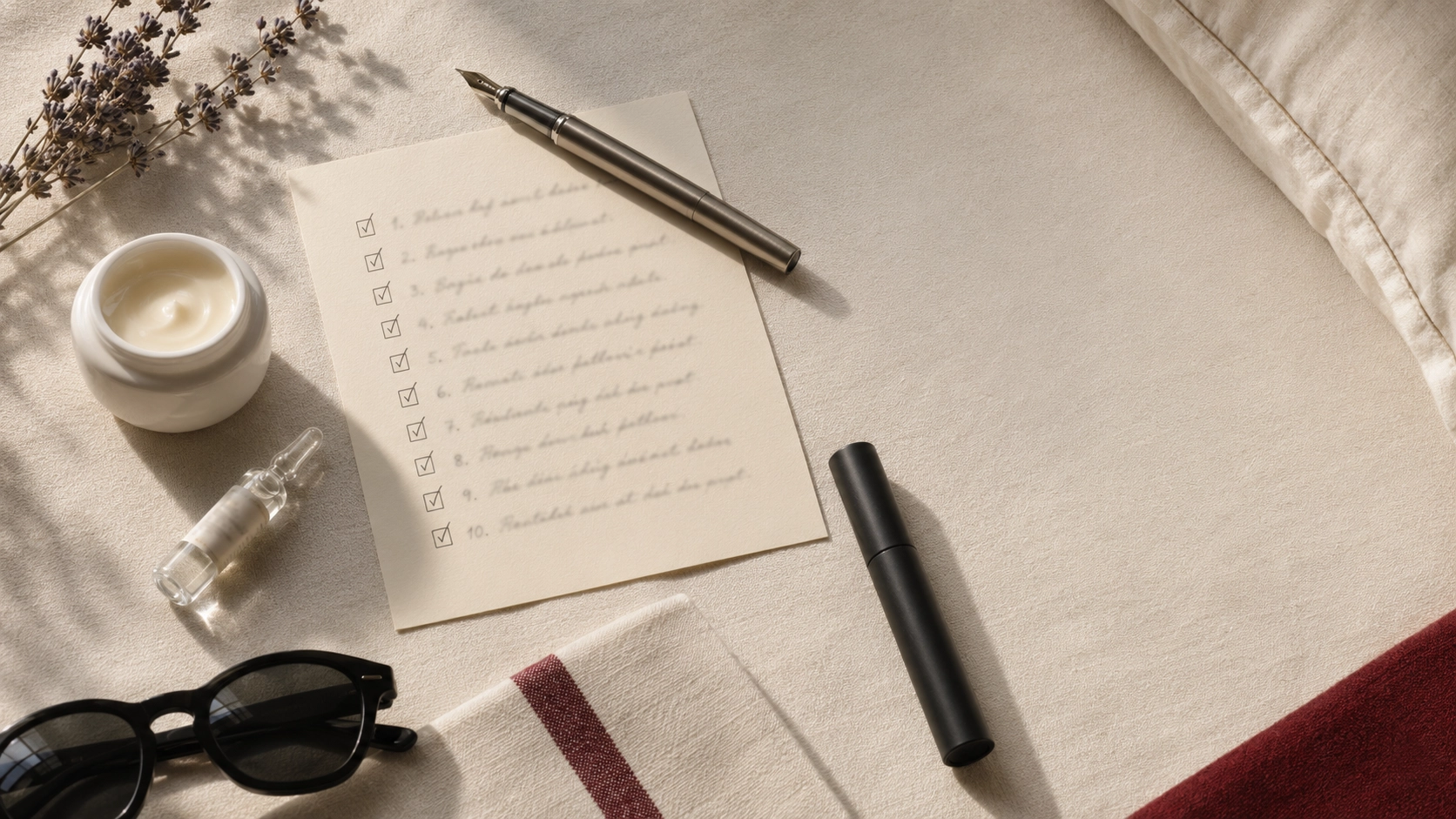
Aftercare is not an art — it is a checklist. Most patchy eyeliner results do not come from a bad artist; they come from rule 4 (a side-sleeping night), rule 7 (an old mascara), or rule 9 (alcohol on Day 2). Print this page, tape it inside a cupboard, follow it for 14 days. The next time you book a touch-up will be in 18-24 months for normal fade — not in 6 months for damage.
Frequently Asked Questions About Eyeliner Aftercare
What if I accidentally smeared the eyeliner on Day 1 — is it ruined? +
Almost certainly not. One incident of side-sleeping or pillow contact in the first 24 hours usually creates an asymmetry of 1–2mm that your week 6-8 touch-up easily corrects. The problem is repeated friction night after night, not a single mistake. If you notice a smear, text your artist a photo — they will tell you whether it is within touch-up correction range (almost always yes) or whether to come in for an early assessment (rare).
Can I use a humidifier in my bedroom during healing? +
Yes, and it actually helps. Dry indoor air (especially Markham winters) accelerates flake-and-scab formation, which makes itching worse. A cool-mist humidifier set to 40-50% relative humidity during Day 4-14 reduces tightness, slows premature flake lift, and improves the ghost-phase resurfacing slightly. Avoid warm-mist humidifiers within 1m of the bed — they can deposit fine droplets that recreate the no-tap-water risk.
When can I get a brow tint or lash lift? +
Brow tint: from Day 21 (no contact with the lash line). Lash lift: minimum week 6, ideally after your eyeliner touch-up has fully healed (week 10-12). Both involve chemical exposure within millimetres of the still-stabilising pigment edge — premature application is the most common reason clients report 'my eyeliner suddenly faded' at 8 weeks. If you have an appointment booked within these windows, reschedule it.
My eye is itching badly on Day 5-6 — what can I actually do? +
Tap gently with a clean fingertip (never a nail); apply a cool gel pack wrapped in a clean cotton cloth for 5 minutes (never directly on skin); or take an over-the-counter oral antihistamine like Reactine (cetirizine) 10mg or Claritin (loratadine) 10mg — both are safe and reduce histamine-driven itch without thinning blood. Do not use topical anti-itch creams (hydrocortisone, calamine, Polysporin) on the lid — corticosteroids slow healing and Polysporin can lift pigment.
Can I get an eyelash extension fill during the 14-day window? +
No. Lash extensions involve cyanoacrylate adhesive within 0.5mm of the healing eyeliner edge, plus 60-90 minutes of eyes-closed pressure that smears any unset pigment. Wait minimum until week 6, ideally until after your touch-up has fully healed (week 10-12). If you currently have lash extensions, you can keep them through the first session but expect some natural shedding during the Day 5-7 peel phase — do not get a fill during the 14-day window.
I have to attend a wedding on Day 10. Can I wear makeup? +
Eye makeup is the issue — concealer and foundation on the rest of the face are fine. From Day 10 you can apply a very light coat of mascara (new tube only, see Rule 7) on the tips of the lashes — not at the root. Eyeshadow only above the crease, not on the lid. No eyeliner over the healing line. Remove all makeup the same night with a wet cotton pad and sterile saline (not micellar). Day 15+ you can return to full eye makeup.
Do I need to wear sunglasses indoors for the first 14 days? +
Not indoors — but yes outdoors, even on cloudy days. UV penetrates clouds at 80%+ intensity. Polarised lenses are not required; any UV400 (which means 100% UVA + UVB block) sunglasses work. Bonus: sunglasses also reduce the involuntary squinting that pulls at the lash line during the itchy Day 5-7 phase. A $20 pair from Winners or Costco does the job — this is one rule where premium brand spend is not justified.
What signals 'go see a doctor', not just 'message my artist'? +
Short list. Walk-in clinic or ER for: fever above 38°C, sharp throbbing pain past Day 2, yellow or green discharge, swelling that increases past Day 2 instead of decreasing, or any change in vision. These are rare (under 1% of clients) but they are the only true medical emergencies in eyeliner healing. Mild redness, itching, asymmetry, flaking, ghost-phase fade and even visible scabs are normal stages, not emergencies.
Already booked, or still researching? Here is the full eyeliner cluster.